Showing posts with label Person Centred Thinking. Show all posts

Thursday, 19 April 2012

Ground Rules for Person Centred Thinking and Planning

Linkability's Person Centred Planning Task Group
wrote these ground rules for their
meetings
Whenever we do any kind of person centred thinking or planning, we try to establish ground rules with the focus person and the group.
One set of things to establish early with the person is exactly WHO will be involved, (and often also who won't be involved) which will usually be determined by the purpose of the planning. It's important that we're clear with the person about how we're going to keep them involved or informed about those conversations. We also establish whether any particular topics are 'off limits', or need to be thought about at a different place, perhaps with a different set of people.

There are also rules that can determine how the meeting will be conducted. Often the participants will generate these themselves, but facilitators often have a few rules up their sleeves that they might seek the person and the group's agreement to.

Agreeing a set of ground rules is also a kind of ritual that separates the planning session and planning space from the concerns of normal everyday life. They're a way of saying 'for the next hour or so, we're going to focus solely on the work of thinking together with this person, in a way that requires our careful and mindful attention'. They also make sure that people feel safe and orientated within this space, they understand what is expected behaviour. They're also a summary of the key skills involved in person centred work. It's no accident that the first 3 rules all relate to listening well and welcoming diverging viewpoints in a way that makes sense to all involved.

The rules belong to the whole group, and the whole group has permission to invoke and use them. The person they apply to most of all is the facilitator of the group. They must embody the rules because if they don't follow them, then nobody will.
Here's a short list of possible group ground rules, then an explanation of why those rules are there:

Everyone’s views are welcome.

Listen with respect.

No Jargon

Speak from the heart as well as the head

No fixing

No obsessing/5 minute rule

Inperfect spelling is OK

Do what you need to do to be here/misery is optional

We believe everyone’s views are welcome because the person and everyone who knows and cares about the person and has been invited to participate can impart valuable knowledge that will help us support that person better.

It’s necessary to listen with respect because this is how we make sure that everyone’s views are welcomed. We’ve learned that good listening that gives people time to think helps people think and express themselves better

Jargon is banned because it’s a way that one group of people can maintain power over another. It’s a private language that excludes the person, their family and frontline staff from the discourse. It can be used as camouflage for deep ignorance. If you really understand a concept, you should be able to explain it in everyday English.

We ask people to speak from the heart as well as the head because Person Centred Thinking deals with the world of feelings and emotions as much as the world of facts. We want people in the meeting to feel able to express their emotions so that this is a real discussion about someone’s life, not just a business transaction.

No fixing. We’re not here to ‘fix’ the person, we must ‘accept the person, change the situation’. Nor do we wish to jump quickly to the easiest and most obvious solution. Sometimes spending a bit more time gathering information and defining the problem will help us find actions that are far more creative and productive.


We don’t want to get obsessed with a small detail, or spend more than 5 minutes discussing issues that the people in the room can do nothing about. If we do get stuck on issues like this, anyone can invoke the ‘5 minute rule’, the facilitator can write the issue down, so that it can be taken to the people who CAN do something about it.


Person centred work is not a spelling test. We need all that rich person centred information that’s in people’s heads. So inperfect spelling is OK.

Misery is optional, We want everyone to feel comfortable during our work! If something’s making you uncomfortable, do something about it!

What ground rules do you use in your own person centred planning?

Tuesday, 13 December 2011

What Does it Take To Train People in Person Centred Thinking?

If you’re going to take that step of standing up and teaching person centred approaches to others, then It's obvious that you need to know and understand how to use the person centred skills and tools you wish to teach.

To me it's also obvious that you must have a deep commitment to the values the underpin person centred approaches, you must also be hungry to learn more, and be eager to share what you learn with others, so that more people can be supported better to build better lives, with valued social roles in their community.

Background knowledge of the social model of disability, of Social Role Valorisation theory, of the five accomplishments, of capacity thinking will give a trainer good grounding. Your thirst for further knowledge will help you learn these things if you don't know them already.

Without doubt, you'll need good mentorship from an experienced trainer, and be able to use every opportunity you can to explore the art of planning and training with others who belong to the community of person centred practitioners, a warm, welcoming community that will appreciate what you bring to it.

But when it comes to standing in front of a group of learners, it's much less a matter of what you know, than about how you help others dig out what they ALREADY know. You must almost forget what you know, and instead work on creating conditions where people lead their own learning, where deeper learning can happen.

Because you're stood up at the front, people will wish to see you as the expert, but person centred thinking is trying to demolish the view that some people are ‘experts’, and that everything must go through the experts in order to be valid. We are trying to build instead the view that everyone has knowledge that is based on their own experience and their own lives, and has the capacity to learn more. The right questions asked in the right way can help bring this knowledge to the surface, and help focus people’s attention onto what they still need to learn for themselves.

This is the trainers’ job: to help people and groups rediscover the knowledge they already have, and stimulate the curiosity to learn more. This is also what person centred thinking aims for. Person Centred Thinking tools are really tools that help people and groups rediscover what they already know, or open them up to seeking for what they don’t yet know.

Therefore in order to train person centred thinking, it’s necessary to train in a person centred way. More important than how you speak and what you say is what happens in the gaps in between: How you LISTEN, how you give people time to THINK, the RESPECT that you show to learners, the gifts they bring with them and the feelings that training evokes.

Poor trainers stand in front of a powerpoint and talk and talk, and talk, and talk...

Good trainers ask questions that stimulate discussion, use techniques that give everyone a chance to think and speak and open themselves up to listen well to everything that the group is saying, with their words and with their whole selves. People learn far more when they voice what they’re learning, and listen to and help each other. Good trainers don't talk for the sake of filling up silences. They don't fear silence. They use silences as a tool, a space where people can think and be together, a space for learners to fill with their own learning.

People learn person centred approaches by immersing themselves in person centred work, not by watching a powerpoint: Conducting an experiential exercise, then discussing the learning from it is the beginning of this, as people use themselves as their own ‘focus person’. Time should be balanced so that 20% is explanation, 80% exploration.
Your learners will know far more than you do about their own work situations and about themselves. Respect this, bring it out. Your job is to ask the questions that will help people allow this deeply stored knowledge to spout upward from their own internal wells, so that it can be pooled and swum in. If you’re doing this right, you will learn just as much as your learners do from a training session. With such deep wells already there, there’s no need for you to be the fountain of all knowledge, learners are not empty vessels, they are full to the brim.

Finn McCool and the Salmon of Knowledge

It was said that Fintann the bradán feasa or Salmon of wisdom, had swum in the well of knowledge, and eaten nine hazel nuts that fell into the well from the nine hazel trees that grew around it, and that therefore this salmon contained all the wisdom in the world. Moreover, it was said that whoever could catch and eat this salmon would in turn, know all there was to be known.
When Finn McCool was a young man, he was sent to learn with the poet and teacher Finegas. Finegas spent 7 years with Finn, and did most of his teaching while they fished together for Fintann, the salmon of knowledge.
Finally Finegas hooked the magic and immortal fish. He was keen to consume it's flesh, know everything, and thus become the greatest teacher there had ever been.
"Start a fire and cook this fish Finn!, but whatever you do, don't eat it, it's mine!" said Finegas.
Finn loyally did as he was told, but when the fish got really hot, fat started spitting out of it, and a sizzling hot drop landed on his thumb. Without thinking, Finn put his thumb into his mouth to sooth it. All the precious knowledge in the salmon was focussed into that little drop of fat, and wham! now it was inside Finn.
When Finegas got back he could see Finn had changed, his eyes were sparkling with experience and wisdom. Finn explained what had happened.
"Finish eating the salmon" said Finegas "It's you who is destined to know, not me".
After that, Finn became the wisest of all leaders. Whenever he was presented with a problem, he would simply suck his thumb, and know exactly what to do.


Monday, 5 December 2011

Learning From Achievements

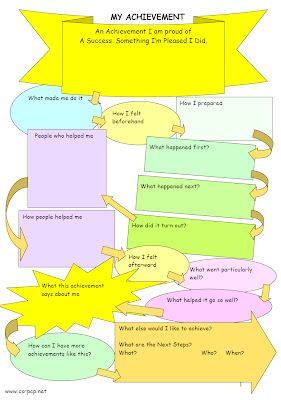
One of the most crucial and fundamental elements of Person Centred Thinking is a deep listening for a person's capacities and potential. One tool that can tell us so much about our capacities, and what we can achieve when we are at our best is the achievement tool, a tool that combines ideas taken from appreciative inquiry (AI), from person centred thinking, and from capacity thinking.

The achievement tool has a few purposes.

The first is simply to make a record of something that we're very proud to have accomplished.
The second is to celebrate that accomplishment.

Our achievements tell us so much about ourselves.
To find out more about the Achievement Tool, pleas click on
the picture.


The third is to draw out learning from what we have achieved: learning about what it is that helps us achieve.


 I've used this tool many times over the last few years since I first designed it in a burst of creativity stimulated by Gill Bailey and Helen Sanderson's training, and by my own research into AI.

I realised how powerful this tool was the very first time I used it with a group. Several members of the group were shedding tears as they told their achievement stories. The whole group felt we were entering important and fertile territory for inquiry, and were able to express so much appreciation for each person after they had told their story. As each story unfolded, the energy in the room grew increasingly hopeful and postive, people left feeling genuine connection with each other and a sense of personal empowerment.

Talking about our achievements is not always easy for people from the English culture. We don't like to 'blow our own trumpets'. But when we do, we go very deep into who we are, what drives us, some of our very deepest feelings.

Appreciative Inquiry is based on the idea that what we inquire into expands. If we inquire into a person's faults and deficits, we will continue to find more and more, until the picture we have painted of them becomes positively debilitating. If we inquire into a person's achievements, we learn more and more about what helps that person achieve, and potentially enable that person to achieve more and more.

The Achievement Tool links directly to other person centred thinking tools.
For example, the question 'What made me do it?' links directly to what is most important to us.
Sometimes people use the tool to tell stories of how they have overcome adversity such as leaving a long term partner, or overcoming a situation that has been thrust upon them. Sometimes it is an achievement of something that they have chosen to attempt. In either case it can help us understand our own key priorities.

'People who helped me' helps us learn more about our real circle of support: the people who are around when we are achieving things, rather than the people who somehow hold us back.

'How people helped me' and 'What helped it go so well?' give us clues about what makes good support for us. If we can recreate the conditions that existed last time we achieved something great, perhaps we can go on to achieve more!

'What this achievement says about me' explores the capacities that the achievement reveals within us. I like to call it like and admire, but with an evidence base.

There's a number of ways to use the tool. It can be used with individuals, teams and even with whole organisations. Even if the only achievement your team can think of is that they organised a really good leaving do for a colleague, the learning from that can give clues about talents and skills within the team that could be applied to the core work of the organisation.

I tend to start by asking everyone in a group to think of something they have achieved. It could be big or small, and I point out that this is not an 'achievement competition'. We can often learn just as much useful information from a small achievement like baking a cake as we do from a major life-changing achievement.

When everyone has mentioned what their achievement is, I ask for volunteers to explore their achievement more deeply. It works to split people into groups of 3, one person to talk more about their achievement, one to ask them questions, and one to record the answers in a way that makes sense.

When people have recorded their achievement, they go back to the whole group and are helped to recount their achievement story. Each story ends with a round where everyone in the group tells the person what they appreciate about them and their achievement.

It's a great way to end a training session so that everyone feels on a high, ready to go out and achieve more!

A lot of organisations are finding it hard to talk to social care commissioners in the language of outcomes, rather than inputs. Using the achievement tool with people we support gives us a real picture of what people feel are the real achievements and outcomes in their own lives. People have used the tool to describe how they gave up smoking, how they recruited their own staff members, how they made new friends, how they used a train independently for the first time.

Teams have used the tool to celebrate winning new tenders, supporting a person to successfully lose weight, in a way that made sense to them, and helping a person whose previous support arrangements had repeatedly broken down to build a successful life in the community.

Here's what Amanda George thinks of the Achievement Tool.

What achievements do you feel proud of? Have you explored what motivated you, and helped you accomplish them? What else could you achieve if you really paid attention to what helps you be at your strongest and best?